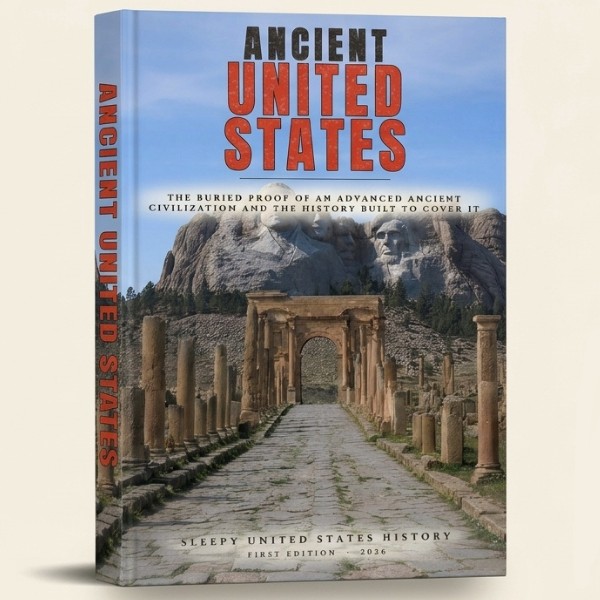
The largest geometric earthworks on earth. Desert canals engineered to a few inches per mile. An 18.6-year lunar cycle built into fifty acres of soil, and a city on the Mississippi larger than London. This illustrated field guide lays out what is actually in the ground, and the story that was written to explain it away.
“I've driven past the Newark earthworks my whole life and thought it was a golf course. The Octagon and the Moon chapter had me standing on the observation platform the next weekend, working out the moonrise line myself.”

Denise R.54, Chillicothe, Ohio
“I came for the giants and the Smithsonian cover-up. The book told me straight that the giants don't hold up, then showed me Cahokia, which is twenty minutes from my house. The real story beat the one I came for.”

Mark T.49, Collinsville, Illinois
“The Bretz chapter got me. I've fished those coulees for forty years without knowing a flood cut them. The What Holds Up sections are the reason I trust the rest of the book.”

Gary W.67, Spokane, Washington
A video says the Smithsonian collected thousands of giant skeletons from American mounds and destroyed them, and it does millions of views. A correction explains what the old reports actually recorded, and almost nobody sees it.
The correction is right. What it leaves out is that the true story under the fake one is bigger than the fake one ever was.
A hundred-foot mound with a base bigger than the Great Pyramid's. Copper worked eight thousand years ago. Footprints in New Mexico more than twenty thousand years old.
None of it needs a lost race, a Viking expedition or a secret vault. It only needs you to accept that the people who were already here built on a scale nobody was taught about.
There's a real cover-up in this too, and it doesn't involve a smoke-filled room. It was a nineteenth-century myth about a “vanished race”, repeated in textbooks for a hundred years and used to justify removing the builders' descendants from their land. Ancient United States goes through all of it, one short chapter at a time.
| Viral videos | School textbooks | Ancient United States | |
|---|---|---|---|
| The builders | Giants, Atlanteans or aliens | A paragraph on “mound builders” | Poverty Point, Newark, Cahokia and the Hohokam canals, with measurements |
| Famous mysteries | Sold as proof | Ignored | Kensington, Bat Creek and the Michigan Relics, each weighed and given a verdict |
| Timeline | “Older than they admit”, with no source | Clovis first, 13,000 years | Meadowcroft, Topper, Paisley Caves and White Sands, with dates and arguments |
| The cover-up | A secret society | Not discussed | The vanished-race myth, the removals and where the bones went |
| Honesty check | None | None | Every chapter ends with What Holds Up |
| Using it | Endless scrolling | A semester | 90 short chapters, plus a guide to sites you can visit |
Seven parts, ninety chapters and six appendices, starting with what's firmly dated and ending with how the official story was put together. Here's a sample from the real table of contents.
Chapters 1–12 · the ice, the flood and the drowned coast
Chapters 13–26 · earthworks on a scale nobody was taught
Chapters 27–39 · chambers, wheels, canals and the Sun Dagger
Chapters 40–52 · the fall of Clovis First
Chapters 53–65 · runestones, tablets and the copper question
Chapters 66–77 · destroyed sites, giants and the archive gap
Chapters 78–90 · a myth, what it was for, and what it cost
Ancient United States comes from Sleepy United States History, made for the parts of the deep past that the headline version skips.
It's a book about evidence, and every chapter is built around one question: what is actually in the ground, and how do we know? Some of the most famous mysteries in American alternative history are covered here and then taken apart. What's left is stranger and better documented than the myths.
Nothing asks you to take anything on faith. Every major site named can be visited, and every major claim can be checked. Some of those sites are sacred and still in ceremonial use, and the book treats them that way.
No. The book is organized around evidence. Every chapter ends with a section called What Holds Up, which says plainly what's established, what's contested and what doesn't survive scrutiny. If a famous story is a hoax, the book tells you so and explains why.
A video gives you the claim. The book gives you the claim, the site, the dates, the counter-argument and a verdict, all in one place, across 90 chapters and six appendices. That includes a list of sites you can actually visit and a state-by-state guide to what's under your feet.
We'd like this to be the first book people pick up on the subject, and a low price helps. The price is set for the launch and may change later.
It's an illustrated 142-page PDF. As soon as checkout on Gumroad is complete, you can download it, and a copy is emailed to you. It works on any phone, tablet, e-reader that opens PDFs, or computer, and it's yours to keep.
No. Each chapter is short and stands on its own. Start with Cahokia, White Sands or the Kensington Runestone, whichever caught your eye.
Yes. The book notes that some sites are sacred and still in active ceremonial use, and it asks readers to check current access rules and permissions before visiting any location it describes.
90 short chapters, 7 parts, 6 appendices and an honest verdict at the end of every chapter.
Get Ancient United States — $14.99
142 illustrated pages and 90 chapters, each with an honest verdict at the end. The launch price ends when the timer does.
Get Ancient United States — $14.99